Se descubrieron unas huellas misteriosas en el fondo del Gran Agujero Azul, el sumidero oceánico más grande del mundo, el cual se ubica a alrededor de 96 kilómetros de la costa de Belice.
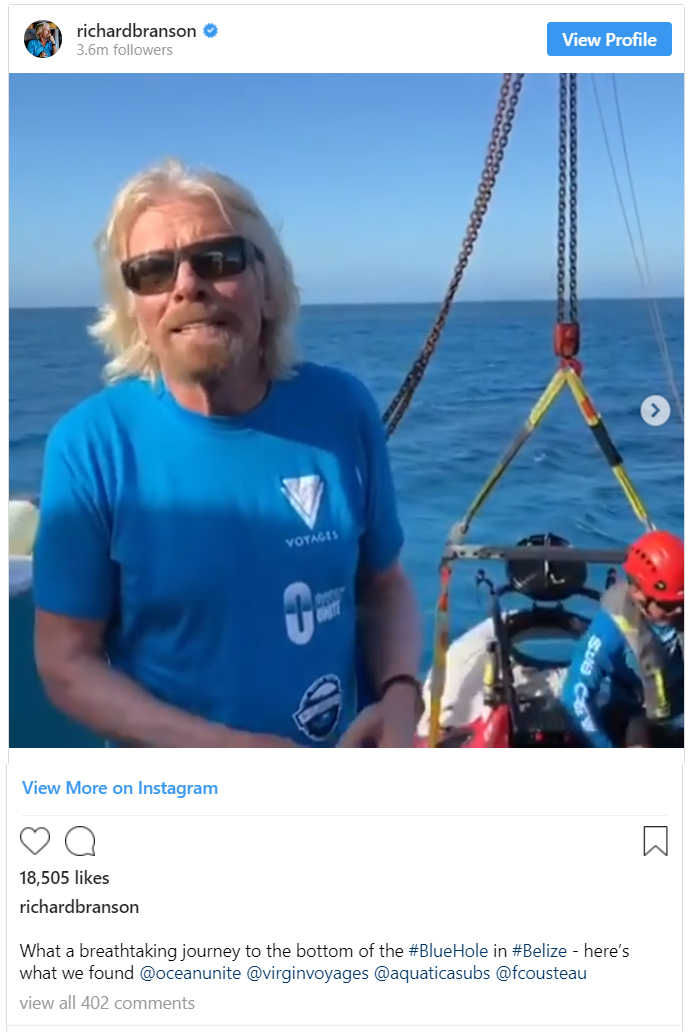
En diciembre del año pasado, un equipo de exploradores, incluidos el multimillonario Richard Branson y Fabien Cousteau, nieto del explorador francés Jacques Cousteau, participó en una misión para sumergirse hasta el fondo del sumidero y descubrir lo que había allí abajo. Con sus más de 300 metros de ancho y 125 metros de profundidad, es una maravilla natural muy poco explorada.
https://youtu.be/0NKAdJkng4Q
Se formó como una cueva de piedra caliza hace cientos de miles de años, cuando el nivel del mar era mucho más bajo. Al final de la última era glacial, las capas de hielo se derritieron y subieron los niveles del mar, sumergiendo a la cueva para que se convirtiera en lo que ahora es el Gran Agujero Azul.
En noviembre y diciembre del año pasado, los equipos llevaron a cabo 20 inmersiones en este vacío con el fin de crear un mapa en 3-D. Una de las inmersiones fue transmitida en vivo en el Discovery Channel. En esta, Branson y Cousteau, encabezados por la pilota submarina Erika Bergman, se aventuraron en las profundidades del sumidero.
En una entrevista con CNN Travel, Bergman habló de lo que vio dentro del Gran Agujero Azul. Ella dijo que hallaron estalactitas nunca antes vistas en la base del sumidero: “Eso fue muy emocionante, porque no habían sido mapeadas allí antes, no se habían descubierto allí antes”. Aun cuando el agua estaba completamente oscura, un equipo de sonar de alta resolución a bordo les permitió ver rasgos ocultos de la formación.
“Puedes estar a 20 o 30 metros de distancia de una estalactita o de un trozo del muro y ver los detalles a la perfección, mejor de lo que podrías hacerlo a simple vista”, dijo ella, añadiendo que también encontraron algunas huellas no identificadas en la base del sumidero, cuyo origen está “abierto a la interpretación”. Los investigadores ahora están cerca de completar el mapa sonar en 3-D del agujero.
“Se ve muy padre, es un escaneo con sonar en red de capas de todos los 305 metros de diámetro del sumidero”, dijo Bergman al sitio web. Una entrada de blog de Aquatica Submarines, que estuvo involucrada en la expedición, decía: “La vista que da el mapa es realzada con otros datos medioambientales pasivos recopilados mediante submarino del Agujero Azul.
En cuanto sea procesada y cotejada, esta información será compartida con el gobierno de Belice y la comunidad científica mundial como un legado de la expedición”.
INGLES
As an unexplored legend of the deep, the Great Blue Hole in Belize is said to hold deep-sea monsters and Maya mysteries.
The first expedition to the bottom has turned up neither of those wonders, but what scientists and explorers have discovered is fascinating – even though it is not, as several outlets have claimed, an unexplained mystery.
In December 2018, after diving 125 metres (410 feet) to the very bottom of the blue hole in a specially equipped submarine, the team noticed something strange. There, on the sand, were a set of tracks.
While it might be fun to imagine, the owner of these prints is not some monster of the deep lurking just out of sight. As it turns out, the truth is less mysterious and more heartbreaking.
It’s true that the tracks are a sign of life, but it’s not flourishing life. Instead, they are the remains of living things struggling to survive at the bottom of the world’s largest sinkhole – a place where the water is anoxic, containing zero oxygen whatsoever.
In a recent blog post, the chief submarine pilot on the expedition Erika Bergman explains that it’s not uncommon for conches to accidentally fall over the edge of the blue hole. Unable to crawl up the steep walls once again, these creatures inevitably suffocate, leading to what she describes as “conch graveyards.”
“We can see each conch with little tracks back up the hill trying to escape, then a slide mark where it slid back down after presumably being asphyxiated in the anoxic environment,” writes Bergman.
“So much sand billows down the steep rim of the hole at this location that fallen conch must be getting covered up quickly, so the sheer number of visible shells is a pretty good indicator that the conch population is healthy – it’s slightly morbid but describes something positive.”
The expedition was made in December of last year, and the team included not only Bergman, but billionaire Richard Branson and Fabien Cousteau, the grandson of explorer Jacques Cousteau.
The Great Blue Hole is a complex system of limestone caves, and before it was drowned by melting ice caps 14,000 years ago, it used to stand on dry land. Today, at over 300 metres wide (nearly 1,000 feet), it remains a largely unexplored natural wonder.
Describing his trip to the bottom, Branson said he was taken aback by how quickly the seas must have risen to engulf such a large hole.
“At 300 feet [91 metres] down you could see the change in the rock where it used to be land and turned into sea,” he wrote in a blog about the adventure.
“It was one of the starkest reminders of the danger of climate change I’ve ever seen.”
Looking out the glass dome of their submarine, the team dove even further, plunging right through a dark fog of hydrogen sulphide, which had gathered over the centuries.
Like a light switch, everything went black. Below the fog there was not a hint of oxygen to be detected.
“It was extremely eerie,” described Branson. “We didn’t expect to see any creatures below. But when we got to the bottom we could see crabs, conches and other creatures that had fallen into the hole, arrived on the bottom and then ran out of oxygen and died.”
Using sonar to peer through the darkness, the team found overhangs, crevices and enormous stalactites, hanging like icicles right near the bottom. It was something that had never been seen before.
“You can be 20 or 30 meters away from a stalactite or a hunk of the wall and see it in every perfect detail, better than eyesight could even provide,” Erika Bergman told CNN Travel.
And then, of course, there was the “conch graveyard.” This was a stretch of the hole where the team saw hundreds of dead conches, at last defeated in their escape.
This wasn’t the only expedition, by the way. In November and December, the teams made over 20 dives into the nooks and crannies of the blue hole, and now, as a result, we have the first complete 3D map of this natural wonder.
At no point was a monster or a Maya mystery ever found. Instead, the most terrifying discovery were the consequences of our own history. Even here, it seems, there is no escape from ourselves.
“Well, the real monsters facing the ocean are climate change – and plastic,” writes Branson.
“Sadly, we saw plastic bottles at the bottom of the hole, which is a real scourge of the ocean.”
“Hopefully by this trip taking place we have raised even more awareness of the need to protect the ocean and tackle climate change now – before it is too late,” he adds.
You can watch footage from the expedition at Discovery.
Fuentes: Newsweek / Sciencealert
